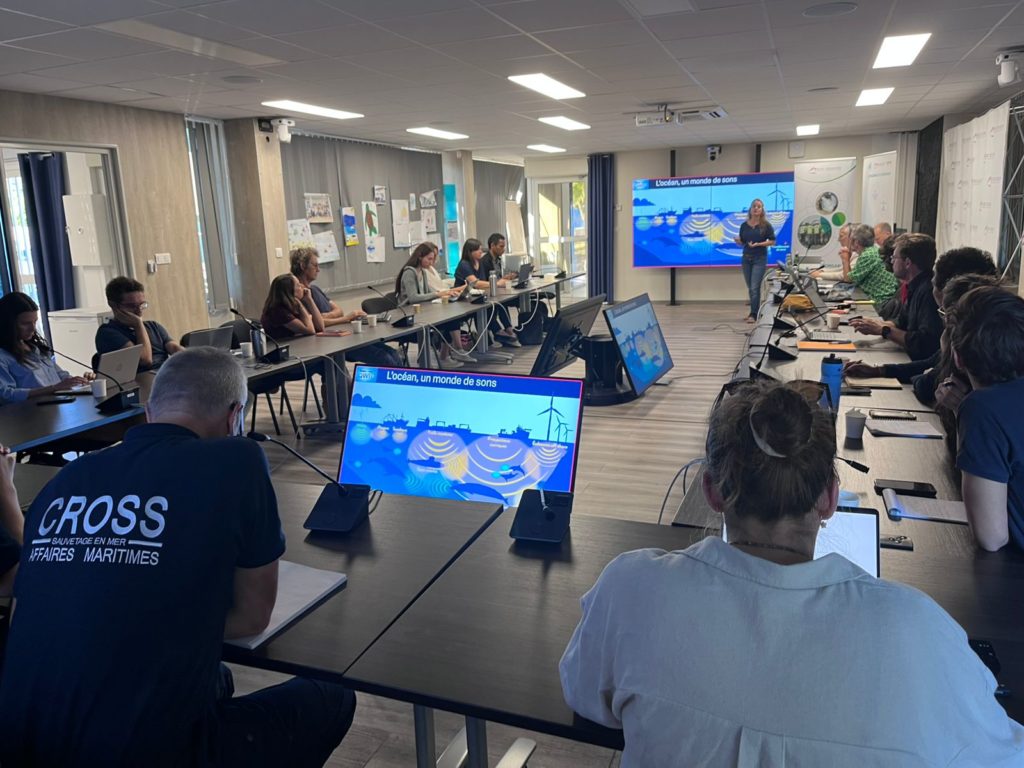
QWIO workshop in Reunion
As part of the Quieter Western Indian Ocean (QWIO) programme, a workshop on the impacts of marine traffic and underwater noise on marine mammals was held in La Réunion on 24–25 June, organized by Globice Réunion, the Wildlife Conservation Society (WCS), Bureau Veritas and Quiet Oceans. The event brought together scientists, public authorities, port managers and maritime stakeholders at the Grand Port Maritime de La Réunion to share the first scientific results and to discuss practical solutions for reducing underwater noise and vessel-strike risks.
Maritime traffic in the Western Indian Ocean is increasing rapidly, driven by the growth of international trade and, more recently, by the rerouting of vessels around the Cape of Good Hope in response to the geopolitical situation in the Middle East. Assessing underwater noise and its impacts on marine ecosystems at the scale of an entire ocean basin remains a major scientific challenge. Through passive acoustic monitoring, spatial modelling of underwater noise and vessel-strike risk, the QWIO programme aims to build the scientific foundations needed to support evidence-based management of major threats in marine ecosystems.
The workshop reviewed current scientific knowledge on the impacts of marine traffic on marine megafauna, presented the first results for Reunion, and explored realistic mitigation measures, including optimized shipping routes, speed reduction strategies and other approaches that can benefit both marine biodiversity and sustainable maritime activities. Technical solutions to reduce underwater radiated noise from vessels were also introduced.
In La Réunion, acoustic modelling conducted by Quiet Oceans using the Ocean Planner platform demonstrated that the “Area to Be Avoided" proposed by the French authorities and recently adopted by the International Maritime Organization (IMO)—primarily for maritime safety and security reasons—would also provide significant environmental co-benefits for cetacean populations by reducing underwater noise levels in the island’s territorial waters.
QWIO also identified areas of elevated collision risk for humpback whales by combining modelled movement patterns of migrating whales, derived from satellite tracking data, with vessel traffic density, while accounting for the increased probability of collision associated with higher vessel speeds. The results revealed localized high-risk areas around La Réunion, in shelf waters of southern Madagascar and along the east coast of South Africa. These results were also presented to the IWC Scientific Committee in April, and both Madagascar and South Africa are now listed as high-risk areas in the IWC Vessel Strike Strategic Plan.
Targeted mitigation measures in these areas could substantially reduce the risk of ship strikes. These may include reducing vessel speeds to 10 knots or rerouting shipping lanes 40–50 km offshore to avoid the main whale aggregation areas. Constructive discussions with some shipping companies represented at the workshop highlighted a genuine willingness to assess whether existing shipping routes could be adapted in line with these recommendations.
Protecting marine ecosystems requires strong collaboration between scientists, public authorities and the maritime industry. This workshop represents an important first step and, it is hoped, will foster continued dialogue and collaboration among researchers, decision-makers and industry, contributing to quieter and safer oceans.
Contributors : Violaine Dulau, Tim Collins