Networking, communication and link with international institutions
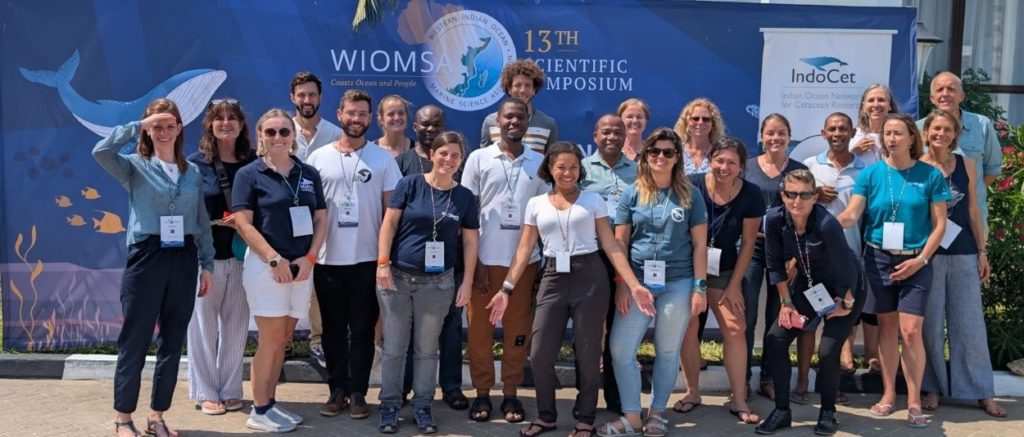
The most recent in-person IndoCet meeting was held in October 2025 during the WIOMSA symposium in Mombasa, Kenya. The meeting report is available here. During the meeting the idea emerged among research for the need to develop a regional action plan to support the conservation of cetaceans in the region. The action plan would identify knowledge gaps, identify major threats and define priority actions.
The work of IndoCet was summarized in a paper for the recent meeting of the IWC SC (paper number SC/70/SAN/03rev1), held in Bled, Slovenia on 27 April-8 May 2026. The paper was presented by Tim Collins and describes the work of network members across a range of subjects, including strandings, surveys, humpback whale photo-identification, underwater noise, vessel strikes, fisheries interactions and outreach. Additional information was provided on the IndoCet website and associated tools, including the publications database (150 papers), and pages dedicated to strandings, sightings and satellite-tracking. The work was commended by the SC, and included specific encouragement for the development of an Action Plan for the Western Indian Ocean:
The Committee welcomes the comprehensive report on the work of IndoCet, commends the extensive and valuable work conducted within the IOS area, and congratulates IndoCet on its work to address vessel strikes and bycatch. In particular, the Committee recognises the value of IndoCet's proposed marine mammal action plan and its applicability to, and synergy with, future IOS planning. The Committee encourages implementation of the action plan and invites updates for SC71.
Other results from the region were presented at the IWC scientific committee. Paper SC/70/PH/04 (Vogel et al., presented by Elisa Seyboth), reported on the outputs of the HappyWhale comparison and examined movement and connectivity within and between humpback whale breeding stocks (BS) B and C (see more detail below). The Scientific Committee commended the authors and noted the work's potential to advance understanding of humpback population structure, including within the IWC-SORP framework (Theme 4).
The IWC SC also considered two preliminary vessel strike risk assessments from the WIO. Work led by Violaine Dulau (Globice) and regional partners, reported on in SC/70/SAN/03rev1, identified higher-risk areas for humpback whales around Reunion, the southern Madagascar shelf and along South Africa's east coast. The work demonstrated that shifting shipping lanes approximately 40 km south of the southern Madagascar shelf could substantially reduce risk for humpback whales with very limited cost to shipping in terms of time or distance. The next steps for this work include assessing whether shifting traffic outside of the core area of concern for humpbacks would adversely affect other species (for instance sperm whales) and whether specific measures for multiple sites can be linked to provide more complete routing advice for shipping companies.
An assessment for South Africa's west coast (SC/70/HIM/01; Vermeulen et al.) combined species-distribution models for six large whale species (southern right, humpback, Bryde's, fin, sei and sperm) with AIS-derived vessel-traffic density in Southwest South Africa. The work identified extensive overlaps between whale habitats and shipping lanes in the approaches to Cape Town and Saldanha Bay, an area where humpback “supergroups” gather. The fastest large-vessel traffic (>15 knots) has roughly quadrupled from December 2023 to 2024 as ships normally bound for the Red Sea rerouted around the Cape of Good Hope given terrorist concerns. The work showed that moving traffic further offshore and out of the core distributions of focal whale species, added less than 20 nautical miles to the total transit of most vessels but could cut relative strike risk by 20–50% across species. Recorded vessel strikes in this region are almost certainly a severe undercount: just 0.6% of more than 7,000 cetacean mortality and morbidity records (1969–2024) were attributed to collisions.
The Committee also drew attention to the acute and growing risk of vessel strikes in the region and recommends funding for a proposed multi-stakeholder workshop in Cape Town (SC/70/RP/66) on vessel-strike risk in South African waters. The Committee provided the following recommendations:
Noting the high risk to humpback whales off southern Madagascar and to several species off the west coast of South Africa, the Committee recommends that:
(1) Both these areas should be considered as high-risk areas in the IWC Vessel Strike Strategic Plan;
(2) Further work is conducted to investigate risk assessments for the south and east coasts of South Africa.
The Scientific Committee also discussed the Indian Ocean Sanctuary, which was established in 1979 but has never had a management plan or a mandated process for review, which effectively renders it useless for current management concerns. The Scientific Committee encouraged the Commission to adopt a proposed IOS Management Plan and review criteria (modelled on the Southern Ocean Sanctuary). The proposal is available in the final report of the Scientific Committee (Annex N). An intersessional correspondence group (ICG-IOS PLAN) was established to take the plan forward. IndoCet is named as an implementing partner throughout the proposed plan, which includes provision for a specific Western Indian Ocean Cetacean Action Plan that could be taken forward for endorsement at the Nairobi Convention.
Note that all papers and reports are available via the IWC website.
Contributor : Tim Collins